Improve the public signals that help search engines, AI systems, assistants, and customers understand what you do, who you serve, and why your business is credible.
Discovery is for the gap between what your business actually does and what AI systems, search engines, crawlers, and answer tools can confidently read from your public website.
Your services are real, but AI tools summarize you vaguely, skip key offers, or recommend competitors first.
Robots access, sitemap behavior, schema, service pages, trust signals, and optional AI-readiness files are missing, blocked, or inconsistent.
You need to know what can be improved on the current site before deciding whether a larger website project makes sense.
You want the blockers, the likely impact, and the implementation steps explained without a vague SEO report.
The goal is not to chase every AI trend. It is to find the gaps that keep your business from being clearly read, cited, and recommended.
Public-facing clarity matters before paid traffic, automation, or a full rebuild can do its best work.
We check whether search and AI tools can identify who you serve, what you offer, where you operate, and the proof that supports your business.
Clear service pages and technical signals make your business easier to describe accurately.
The audit looks beyond a single file or SEO checklist. It reviews whether the business is technically accessible, clearly explained, structured for machines, supported by proof, and accurately represented in AI-assisted discovery.
We test how AI systems describe the business, whether key services are missed, and where competitors appear stronger.
We organize site data and business information so search and AI tools can represent your services more consistently.
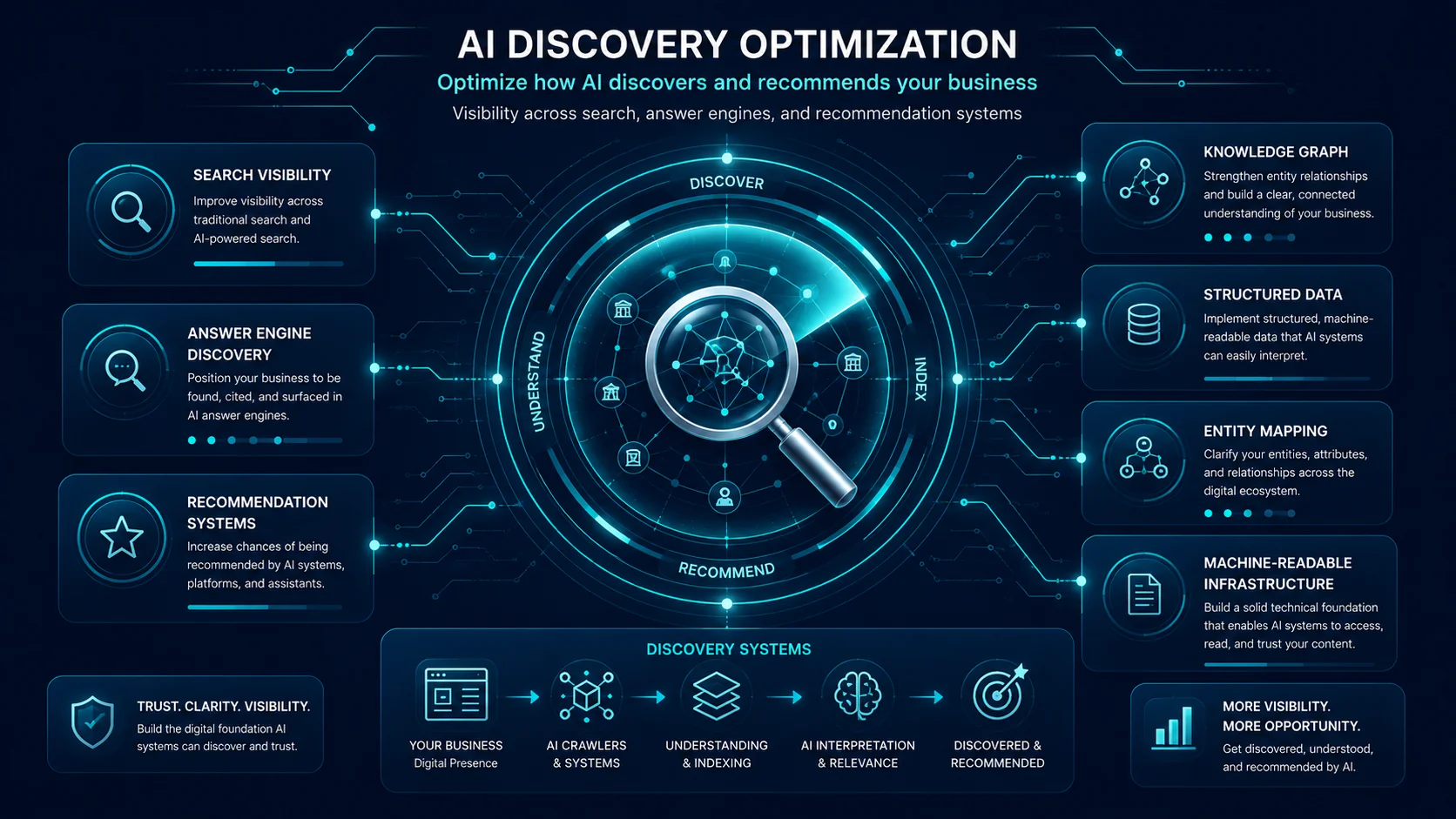
Three focused steps inside the broader AIDO Method.
A 0-10 visibility score that summarizes how clearly the business can be found, understood, trusted, and recommended.
We clarify services, pages, metadata, and machine-readable context so systems can understand what you offer and who you serve.
We review how AI tools describe, compare, omit, or miscategorize the business so the fix path is based on real behavior, not assumptions.
We strengthen structured signals, proof, and service information so the business is easier to understand and verify.
More Visible in AI Answers
Source: GEO study, Aggarwal et al. (Princeton / IIT), KDD 2024
Projected Drop in Traditional Search by 2026
Source: Gartner, 2024
These checks help identify gaps that can make it harder for customers and search tools to understand the business.
Schema, page hierarchy, service language, and entity signals help AI systems understand what the business actually does.
Robots rules, sitemap behavior, canonical URLs, and redirects can quietly decide whether the site is easy or frustrating to read.
AI-readable files, service summaries, citations, and business facts reduce confusion across search and answer environments.
The audit turns the score into next steps: what to fix now, what can wait, and when a larger rebuild is worth considering.
Files like llms.txt and llms-full.txt can help future assistants, retrieval agents, and research workflows understand your business faster. They are useful readiness signals, but crawl access, structured data, clear service language, and trust signals matter more today.
A plain-language map of who we are, what we offer, and which pages matter most for future assistant and retrieval workflows.
View file arrow_forward menu_bookThe deeper reference: positioning, services, and context that can support future AI operating systems and assistants.
View file arrow_forward smart_toySeparates real-time search and user-initiated retrieval access from model-training policy decisions.
View file arrow_forwardEvery page carries JSON-LD schema and FAQ markup so AI can parse our services cleanly.
Built into every pageMove from an instant automated check into a deeper manual audit, a guided fix plan, direct implementation, or ongoing visibility support.
For teams that want the full audit, useful machine-readable files, and a prioritized guide they can implement themselves.
For businesses that want us to implement the highest-priority visibility fixes directly with site access.
For businesses that need a more involved visibility strategy, broader implementation support, or a more custom optimization roadmap.
This is the team-initiated 130-point Discovery process, not the instant automated check. Your completed analysis reviews technical access, business clarity, schema quality, trust signals, AI answer behavior, competitor visibility, AI-readiness files, and the highest-value fix path.